


Page 3 - Reflections_dyslipidaemia_newsletter4_2023
P. 3
REFLECTIONS
                                                                                                                   Dyslipidaemia
     Dyslipidaemia Global Newsletter #4 2023


                                                                at two years, and 58% at three years, which may be due to
             CLINICAL PEARLS FROM THE FACULTY                   the relatively low use of non-statin add-on therapy such as   Dyslipidaemia
                                                                ezetimibe (20% in the treat-to-target group and 11% in the high-
                                                                intensity statin group at three years).

                                                                The results demonstrated here provide evidence supporting the
                                                                suitability of a treat-to-target strategy that may allow a tailored
                                                                approach with consideration for individual variability in drug
                                                                response to statin therapy.


                WATCH                                                    CLICK HERE
                PROF. SHAWKY DISCUSS THE                                 FOR THE LINK TO FULL ARTICLE
                RELEVANCE OF THE RESULTS ON
                CLINICAL PRACTICE.


     Acute LDL-C reduction post ACS: Strike early and strike strong: From evidence
     to clinical practice. A clinical consensus statement of the Association for Acute
     CardioVascular Care (ACVC), in collaboration with the European Association of

     Preventive Cardiology (EAPC) and the European Society of Cardiology Working
     Group on Cardiovascular Pharmacotherapy.
     Krychtiuk KA, et al. Eur Heart J Acute Cardiovasc Care. 2022;11(12):939-949.


     Patients experiencing an ACS are at heightened risk of recurrent ischaemic CV events, especially in the very early phase. There is
     a well-established relationship between lowering LDL-C and a reduction in CV events post-ACS, with the concept termed ‘the lower,
     the better’. The ESC guidelines recommend a step-wise, lipid-lowering approach, but with assessments every four to six weeks; in
     the best case scenario, it may take up to three months for a patient to achieve target goals, which coincides with the highest risk
     period for recurrent CV events. The authors therefore propose a strategy of ‘strike early and strike strong’ with an immediate initiation
     of combined lipid-lowering approach using high-intensity statins and ezetimibe. In patients with high-risk features, acute PCSK9

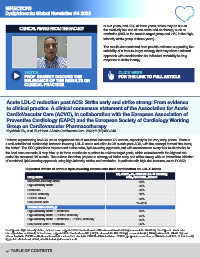
                Expected effects of various lipid-lowering classes and their combination on LDL-C levels
                                                                        Expected proportional LDL-C lowering
                  Drug class                                                  compared with placebo
                  Moderate-intensity statin                                          30%
                  High-intensity statin                                              50%
                  Ezetimibe                                                          20%
                  PCSK9 antibody                                                     60%
                  PCSK9 siRNA                                                        50%
                  Bempedoic acid                                                    15–25%
                  Combination therapy
                  High-intensity statin + ezetimibe                                  65%
                  High-intensity statin + PCSK9 antibody                             75%
                  High-intensity statin + ezetimibe + PCSK9 antibody                 85%
                  Bempedoic acid + ezetimibe                                         35%
     Examples for high-intensity statins, defined as an expected LDL-C reduction of ~50%: atorvastatin 40–80 mg; rosuvastatin 20–40 mg. Examples for moderate-
     intensity statins, commonly defined as an expected LDL-C reduction of 30 (−50)%: atorvastatin 10 (−20 mg); rosuvastatin (5−) 10 mg; simvastatin 20–40 mg; and
     others. Available PCSK9 antibodies: alirocumab, evolocumab. Available PCSK9 siRNA: inclisiran. PCSK9, proprotein convertase subtilisin kexin-9; LDL-C, low-density
     lipoprotein cholesterol; siRNA, small interfering ribonucleic acid.


          TABLE OF CONTENTS

