


Page 2 - Reflections_dyslipidaemia_newsletter4_2023
P. 2
REFLECTIONS
                                                                                                                   Dyslipidaemia
     Dyslipidaemia Global Newsletter #4 2023


     Visual abstract                                                                                               Dyslipidaemia


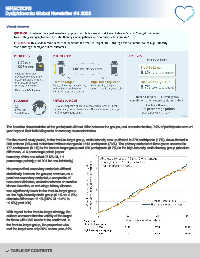
     The baseline characteristics of the participants did not differ between the groups, and at randomization, 74% of participants were ≥1
     year beyond their initial diagnosis or coronary revascularization.

     For the overall study period, in the treat-to-target group, statin intensity was up-titrated in 378 participants (17%), down-titrated in
     208 patients (9%) and maintained without changes in 1614 participants (73%). The primary endpoint at three years occurred in
     177 participants (8.1%) in the treat-to-target group and 190 participants (8.7%) in the high-intensity statin therapy group (absolute
     difference, -0.6 percentage points [upper
     boundary of the one-sided 97.5% CI, 1.1
     percentage points]; p <0.001 for non-inferiority).


     No prespecified secondary endpoints differed
     statistically between the groups; however, as a
     post-hoc secondary endpoint, a composite of
     new-onset diabetes, aminotransferase or creatine
     kinase elevation, or end-stage kidney disease
     was significantly lower in the treat-to-target group
     vs. the high-intensity statin group (6.1% vs. 8.2%;
     absolute difference −2.1% [95% CI −3.6% to
     −0.5%]; p=0.009).

     With regard to the treat-to-target strategy, the
     authors comment that the validity of the target
     for those with CAD needs to be confirmed. In
     the treat-to-target group, the proportion who
     met the target was only 56% at one year, 61%


          TABLE OF CONTENTS

